History of the Atlantic Cable & Undersea Communications
from the first submarine cable of 1850 to the worldwide fiber optic network
CS
Mercury
by Bill Glover
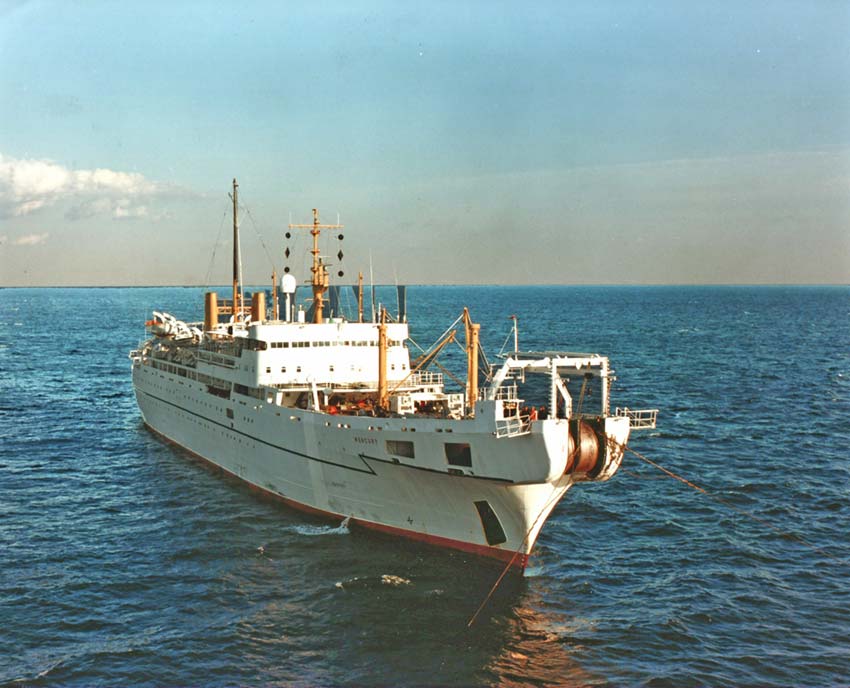
CS MERCURY
CS Mercury repairing cable
Built 1962 by Cammell Laird & Company, Birkenhead
Length 473.0 ft Breadth 58.7 ft Depth 24.6 ft Gross
tonnage 8962
Built for Cable & Wireless specifically to lay
the COMPAC and SEACOM cables with HMTS Monarch (4). This was
the first cable laying vessel owned by Cable & Wireless or its predecessors.
Flagship of the fleet and main cable layer until replaced by Cable
Venture. From then on based in the UK for the maintenance of Atlantic
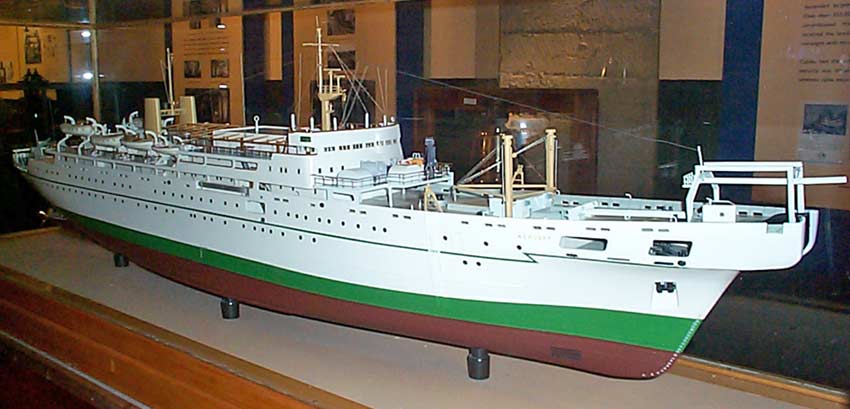
cables. Fitted with three tanks with a capacity of 100,000 cubic feet or
1,100 nm of lightweight cable. Three 10 foot diameter "V" bow sheaves were
fitted initially, later replaced with two flat sheaves, and a stern chute was
fitted to allow laying of repeaters. Seriously damaged after a fire in
the engine room in 1996 while moored at Bristol. Scrapped in 1997.
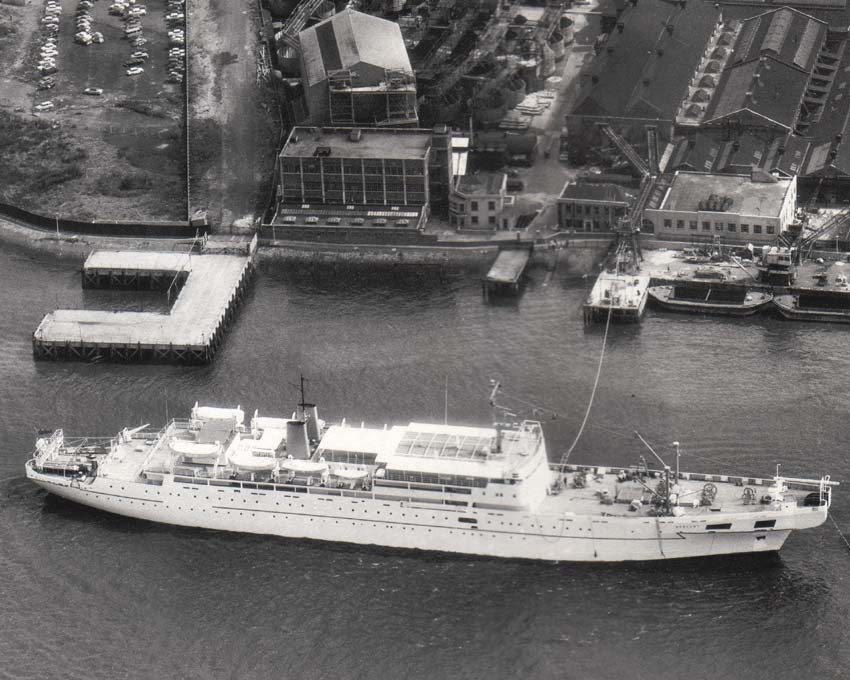
CS Mercury taking on cable at
the SCL premises at Enderby’s Wharf, Greenwich, London, for the Deep Water Bay, Hong Kong - Tumon Bay, Guam section of SEACOM 2. Mercury laid 1,296nm of cable with 51 repeaters.
SCL publicity photograph dated 23 August 1965; Aerofilms image number A150430 marked on the back of the print
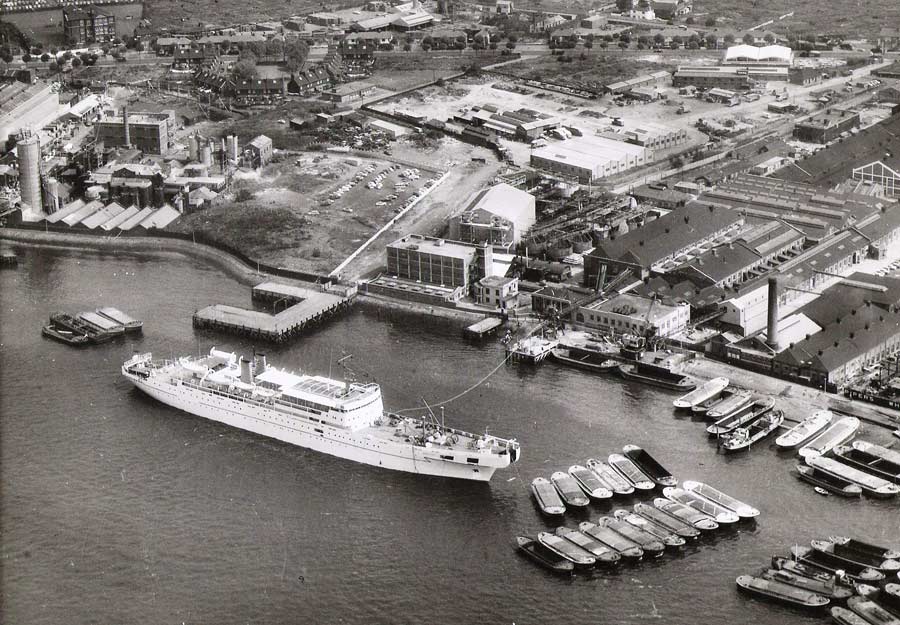
Another view of Mercury loading
cable at Enderby’s Wharf.
The Aerofilms archive at English Heritage lists four photographs made for STC on this date.
Image courtesy of Cyril Malyon; scan by Jim Jones
When CS Mercury was commissioned in 1962, the Cable & Wireless house magazine, Zodiac, published this article by journalist Philip J. Beacall in its October issue. Thanks to James Skinner for providing scans of the article.
Zodiac, October 1962
As Zodiac went to press C.S. Mercury (8,000 tons gross), the world’s fastest and most modern cable-laying ship, was about to leave her berth in Cammell Laird and Co. (Shipbuilders and Engineers) Ltd.’s fitting-out basin at Birkenhead on her sea trials prior to handing over by the builders. After cable-laying trials, probably in the Bay of Biscay, she will load co-axial cable and repeaters at Greenwich, and then sail for Suva to lay the Suva/Hawaii section of the Commonwealth Pacific (COMPAC) cable.
Below is an illustrated article, specially written for Zodiac by Philip J. Beacall, the North of England writer and journalist, who visited the ship last month to watch the finishing touches being given to her by a thousand shipyard workers.
Appended is the first full list of officers and petty officers who will take Mercury to sea after her acceptance under the command of Captain G. H. C. Reynolds.
Mercury Prepares to Make Cable Laying History
by Philip J. Beacall
Even the usually imperturbable English innkeeper could be forgiven for raising an eyebrow when the navigating officer placed an order for “ninety-five pints to be going on with.” But after the fashion of his kind he coped manfully, assisted by his staff, although an accompanying order for sandwiches to go with the beer posed a problem when the bread supplies ran out halfway through the cutting operations.
It all happened on the coach journey bringing the Spanish crew of the new cable ship Mercury from Southampton to join the ship at Birkenhead where she has been built by Cammell Laird and Co. (Shipbuilders and Engineers) Ltd., and it provided yet one more example of the many and varied tasks which Cable and Wireless officers take in their stride. Navigating Officer John Neal accomplished the task of getting the crew safely to Merseyside in the Company’s best tradition, and a more substantial meal and pleasant lodgings awaited them at Liverpool’s famous Gordon Smith Institute for Seamen where they settled down happily until Mercury was ready.
The final weeks of a new ship’s metamorphosis in the shipyard of its birth are always hectic and full of problems. Fitting out the Mercury proved no exception, and the layman, watching an army of nearly a thousand shipyard men putting the final touches before the acceptance trials, could be forgiven for doubting that order could ever come from such seeming chaos. But it does, and the tangled miles of electric cable, the hammerings, sawings and sparkle of acetylene burners are eventually finished with and cleared away. This year shipyard men have had an additional handicap from notorious summer weather which has made such jobs as caulking decks a tricky business.
But, as the chief officer, Captain Robert Bowen Riddle, said during a particularly hectic Saturday morning at the shipyard: “These things have a handy knack of falling into place”, and when Captain G. E. C. Reynolds, C.S. Mercury’s Commander, takes over after the acceptance trials, he is assured of a well-found and happy ship, and the world’s fastest and most modern cable layer as well.
Before that he and his senior officers will have tackled a score of daily problems in dealing with 1,600 cases of stores, 30 miles of grappling rope and buoy rope to be spliced, and thousands of items of working gear and spare gear. There will also be the freighter load of cable for the laying trials off the coast of Portugal or, if the weather is bad, in the Mediterranean, and the important human aspect of forming the new team of officers and men into a happy entity.
The 29-year-old purser, Robert Arthur Gray, has an important role to play, too. For him the most difficult time during the ship’s preparation is the period immediately following her handing over when he must prepare the accommodation for the 135 officers and crew. First task of the purser’s staff is the unpacking of the cases of stores which have been arriving at the shipyard during the immediate months before handing over. They include such items as a thousand pieces of linen, blankets, towels, etc., to make up the 135 berths, 5,000 pieces of glassware and crockery, 2,000 pieces of cutlery and silverware for cabin, saloon and messroom use, and, of course, every conceivable cooking utensil to stock the three modern galleys.
Gray was at Head Office a short time ago completing the order for stocking C.S. Mercury’s pantries and deep freezes with two months’ supplies of victuals and dry goods which included turkeys, mincemeat, dried fruits and similar commodities which will be a feature of the Christmas Day menus.
If the ship’s company get tired of rainbow trout, asparagus tips and other gourmet’s delights, they will have pigs’ trotters, tripe, baked beans and sardines to fall back on, for all these items are included in the bill of fare. Gray has also to ensure the Spanish crew of 74 have food to their taste, and 28 lb. of garlic will make certain their dishes do not lack flavouring!
Gray joined the Company in August, 1957, and was promoted purser the following May. He has served on C.S. Recorder, Retriever, Lady Denison Pender and Electra.
The initial order, which covers over 300 different items, includes more than 3 tons of meat, 224 lb. pigs’ trotters, 100 lb. tripe, 1,000 lb. of ham and bacon, 1,400 lb. of poultry, including 200 lb. of duckling and 400 lb. of turkeys, 31 cases of tinned meats as well as several kinds of sausages, 3,000 lb. of fish, ranging from cod to rainbow trout and salmon, 30 cases of tinned fish, including shrimps, crab, lobster and salmon, 7,200 eggs, 4,000 lb. flour, 4 cwt. of rice, 3 tons of potatoes, 6 cwt. of onions, 36 cases of tinned fruits, 6 different kinds of cheese, 448 lb. of butter, 1 ton sugar, 350 lb. coffee, 300 lb. tea, 50 cases of tinned milk, 250 lb. biscuits, 440 lb. jam, marmalade, syrups, honey, etc., and nearly 1,000 bottles of sauces, pickles, salad cream, vinegar, and 5 lb. of bicarbonate of soda !
The extensive dry and refrigerated storerooms on the main deck include a large deep freeze cabinet which ensures a plentiful change of diet during Mercury’s long periods at sea.
Small wonder then that after all this, and the taking on in London, of 1,200 miles of cable and fifty repeaters, the ship’s company, is rarin’ to go on a maiden voyage to the Pacific which will make cable laying history.
The Officers and Petty Officers of C.S. Mercury
Commander
Capt. G. H. C. Reynolds
Chief Officer
Capt. R. B. Riddle (Acting)
Second Officers
P. Watts (Acting); J. H. Neal
Third Officers
W. J. Venables; D. J. Hider
Fourth Officers
K. M. Humphrey; D. S. Macfarlane
Apprentice
I. R. Bosworth
Chief Engineer
E. M. Pentney
Second Engineer
J. V. Scicluna (Acting)
Third Engineers
R. L. Smith (Acting); K. Routledge
Fourth Engineers
A. P. Taylor; D. Cassidy
Junior Uncertificated Engineers
J. Thompson; J. Jenkins; J. W. T. Thompson
Senior Electrical Engineer
J. M. Hunter
Electrical Engineers
W. T. Robson; J. Coates
Chief Cable Engineer
P. J. A. Cousins
Second Cable Engineers
R. S. Pitt; C. D. Parkin
Assistant Cable Engineers
F. E. Lowe; A. D. Law
Submarine Cable Technicians
A. E. Weekes; P. G. Miller
Radio Officers
J. Otley; J. C. Pyburn; J. D. Cotton
Purser
R. A. Gray
Assistant Purser
——
Surgeon
Dr. L. A. Gess
Chief Steward
C. A. V. Arkell
Boatswain
E. G. Gulliver
Carpenter
W. M. Dix
Deck Engine Drivers
G. R. Logan; J. Beresford
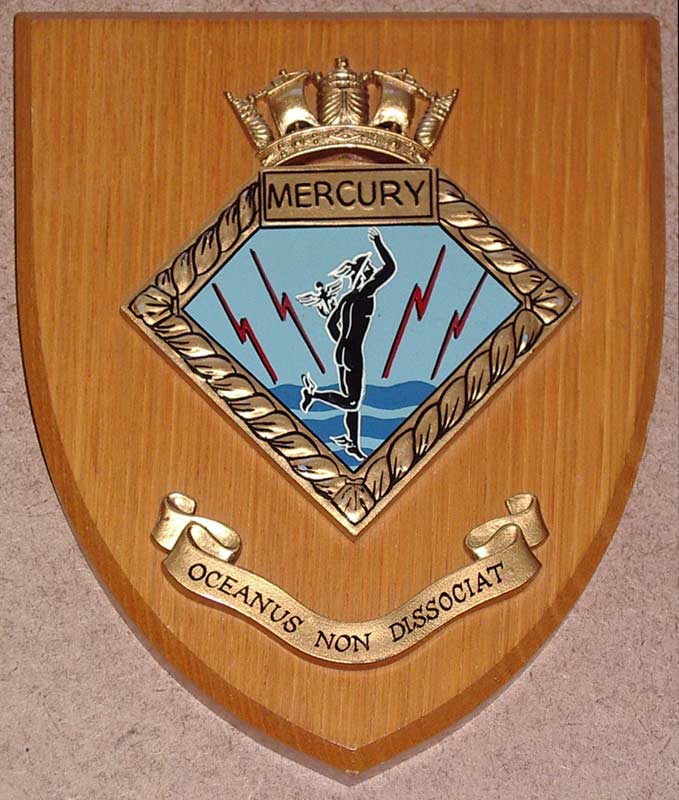
Ship's shield: CS Mercury
"The ocean shall not divide us"
This shield belonged to Captain Charles Goodsir, late Royal Signals Corps. Another for CS Recorder (3) may be seen on the Recorder page
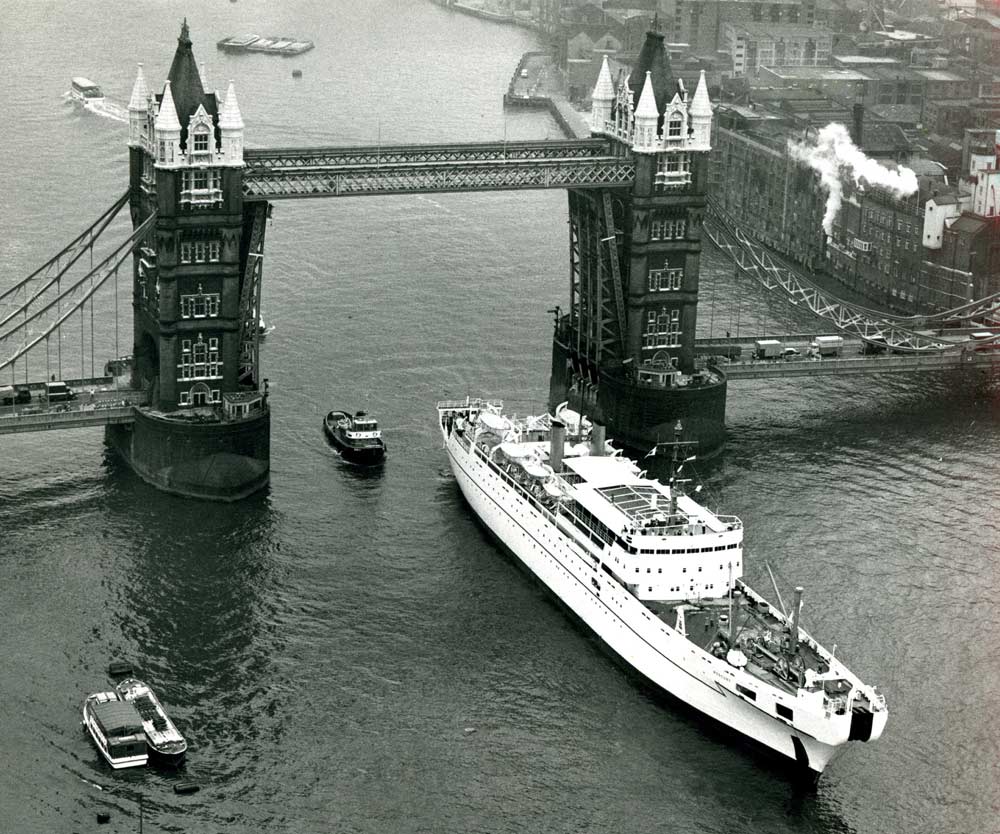
CS Mercury at Tower Bridge, June 1974
Image courtesy of David Griffiths
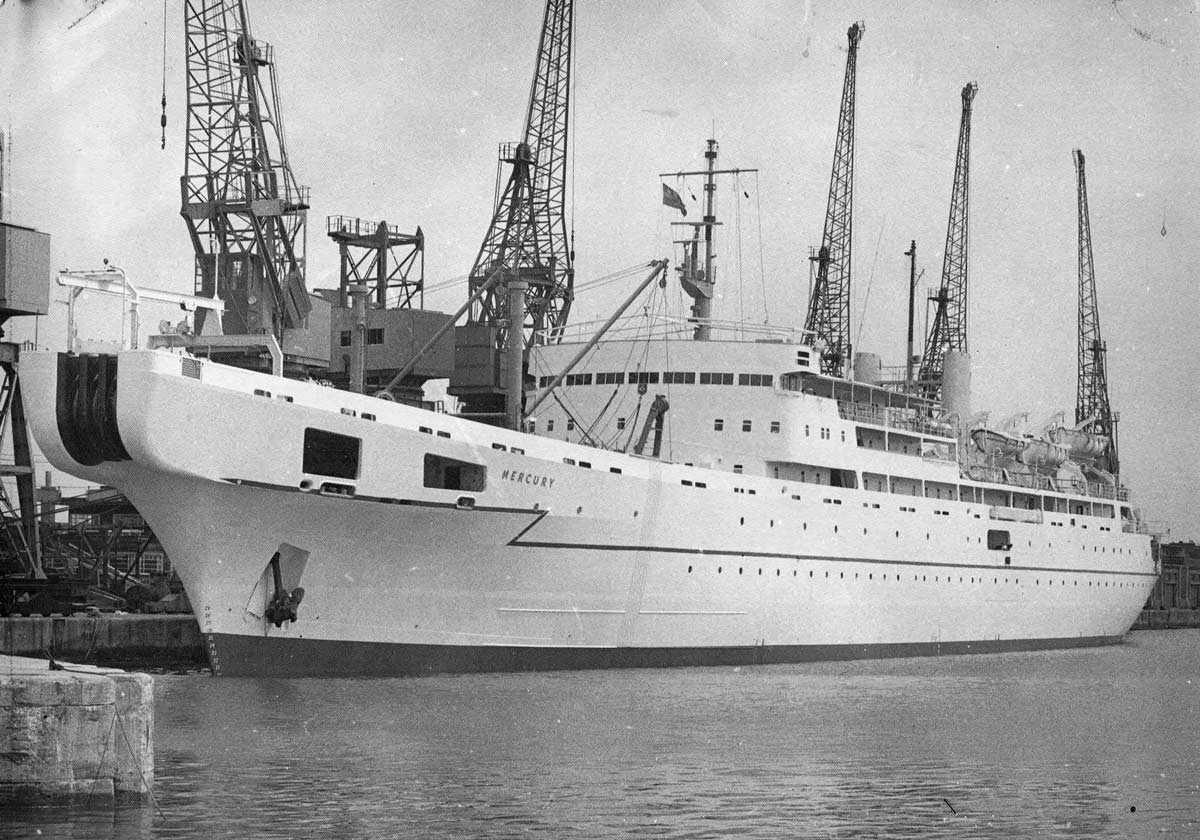
CS Mercury loading cable at Southampton Docks
8mm film shot by Marshall Waugh, 4th Engineer on CS Mercury, during the
Auckland
to Sydney lay of the 1975 TASMAN cable.
The film shows the shore end being laid in Auckland, with footage of the cable & repeaters being fed through the centrecastle & leaving the stern, and also the Bondi Beach shore end going in.
David Howard worked for Cable and Wireless as a seagoing marine engineer from April 1964 until July 1969, serving on CS Mercury, CS Retriever and CS Cable Enterprise (2), and has very kindly provided these photographs of CS Mercury at various locations during the 1960s, together with the notes below. See also David's stories, Losing a Buoy, The Gentleman’s Game, and the Rescue of SS Lakemba.
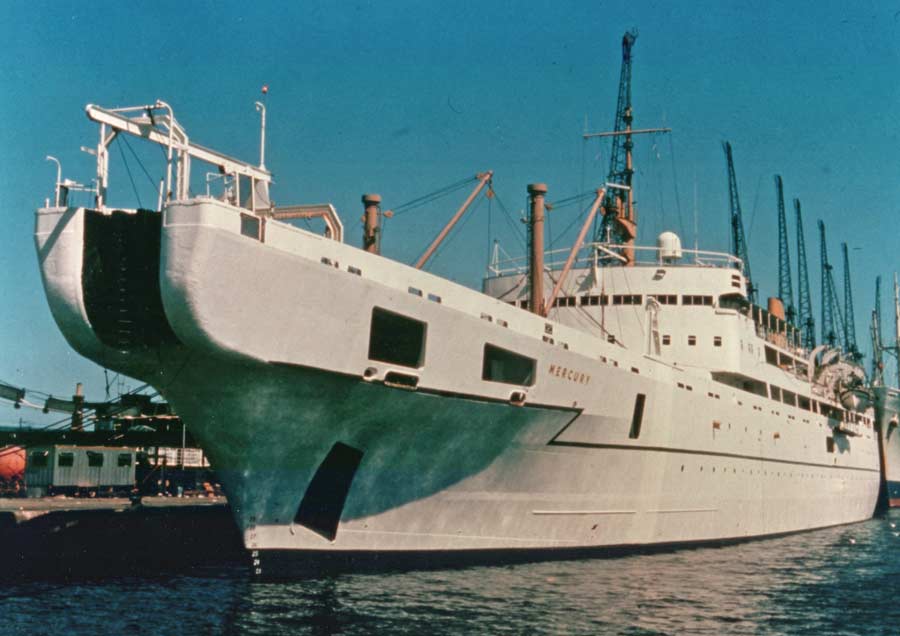
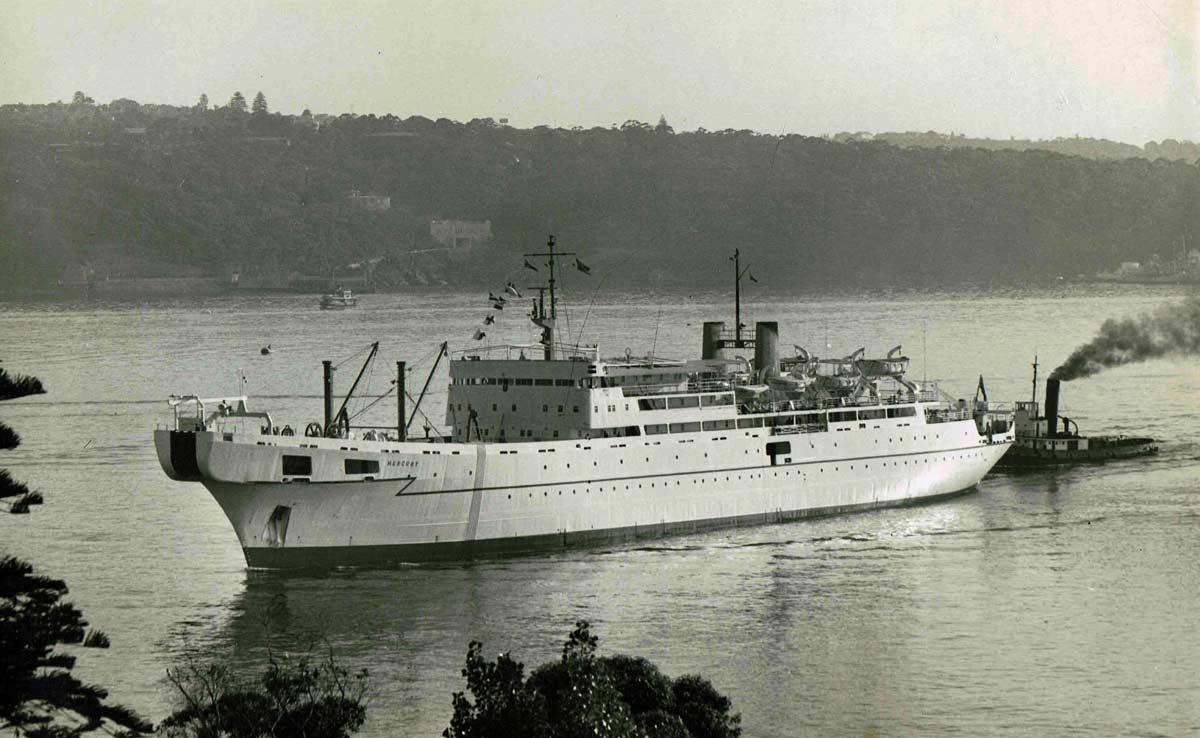
Here is an early photograph of Mercury in Southampton, England, which looks like it might have been taken shortly after she was commissioned—she’s nice and clean!
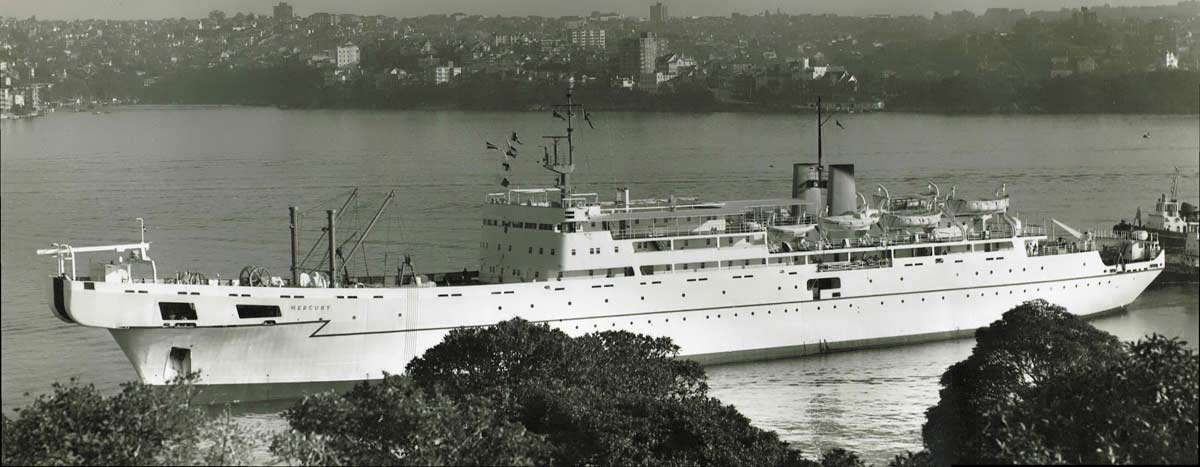
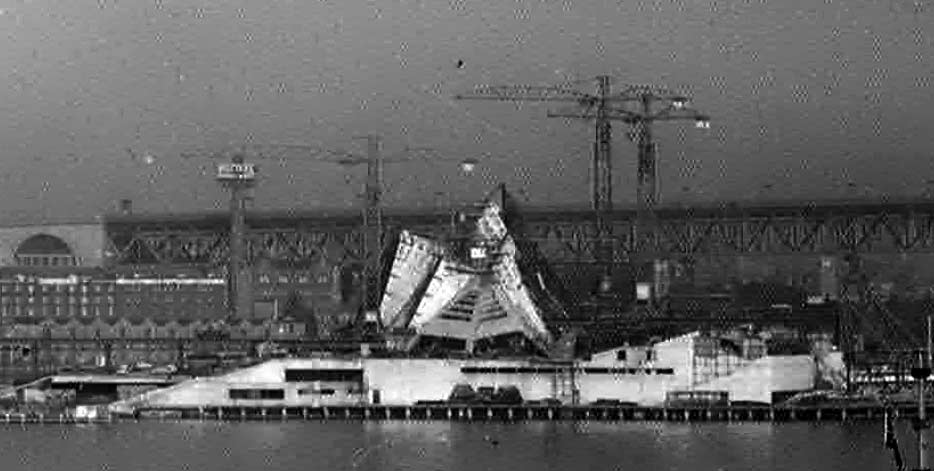
The next three photographs show CS Mercury entering Sydney Harbour on 15th Feb 1965. She went there from Suva, Fiji (10th Feb), to renew the main engines’ pistons.
Interestingly, shortly before that we had to sail out of Suva harbour as there was a hurricane approaching. The C&W Engineer-in-Chief’s Dept. ships' movements log for Mercury of 7th February 1965 reads: "Left Suva (fuel 948) as evasive action for local hurricane. Standing by Nanuka passage. Severe hurricane stationary over West Fiji.” Subsequent entry reads “ Standing by off Suva, awaiting opportunity to return and pick up ship’s papers and crew members before proceeding Sydney.”
That last entry, I think, referred to us returning to Suva after the hurricane. However, I recall us tying up alongside after the hurricane (and I’m pretty sure that somewhere I’ve got a slide of Mercury taken then) so perhaps we had to wait offshore for a berth.
I remember that hurricane well. It formed on February 6th and lasted well into the 10th, so you can see why we sailed to get out of Suva on the 7th. I.S. Kerr's 1976 book, “Tropical storms and hurricanes in the southwest Pacific, November 1939 to April 1969”, published by the New Zealand Meteorological Service, has this description of the hurricane:
The hurricane of February 1965 was probably the worst to afflict Fiji since the 1952 hurricane. Wind damage was not severe except in the Yasawa Group, Taveuni and the northwest of Vanua Levu, but the very slow movement of the storm in the vicinity of Fiji meant prolonged heavy rain and widespread floods which in some areas eclipsed the record floods of March of the previous year.
The cyclone developed near Samoa and moved westward as it intensified. Gales were reported from Wallis and Futuna Islands as it passed close by and a ship near Futuna reported hurricane force winds early on 6 February (Fiji time). At this stage the storm was moving southwest and, later on the 6th, was centred north of Udu Point. From there it moved very slowly towards the Yasawas during the next 48 hours. It then turned southward and remained close to the west coast of Viti Levu for another 24 hours before accelerating away from Fiji on the 9th.
We left Suva as soon as possible after we received warning that the hurricane was approaching, and spent four days and four nights steaming into the teeth of the hurricane with all four engines flat out. The seas were horrific; we couldn’t stand up without holding onto something and all the furniture in the officers’ lounge broke free from its mountings and slid back and forth until it was smashed to bits. There was also considerable damage done to deck equipment and the bow rollers (where cable runs over the bow) were knocked out of alignment!
Taking a shower was quite amusing— the water was vertical as it came out of the shower head, but the floor and walls were one minute leaning at what seemed like 45 degrees to port and the next 45 to starboard, so I had to wait until the water briefly came my way and do my ablutions in fits and starts. I say it was quite amusing, but that’s looking back on it now—at the time the air was black and blue with swear words and cursing.
When we got back to Suva and went ashore we asked the locals what damage the hurricane had done… They said “What hurricane?” The hurricane had completely bypassed Suva! So all that rough weather, discomfort, bruises and damage was entirely unnecessary—although, if we had been caught in harbour it doesn’t bear thinking about!
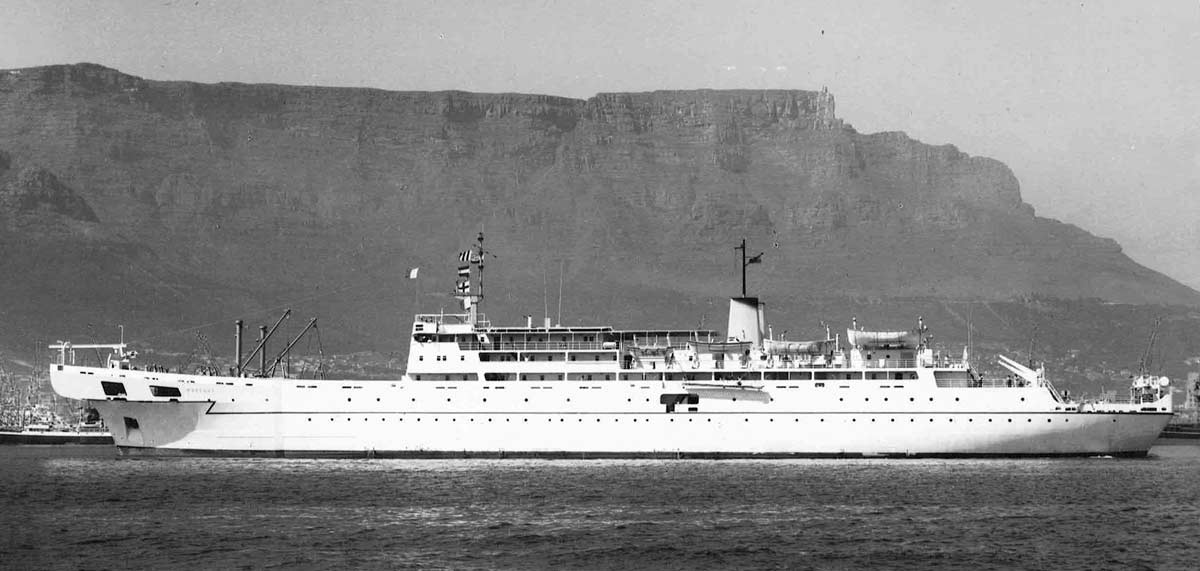
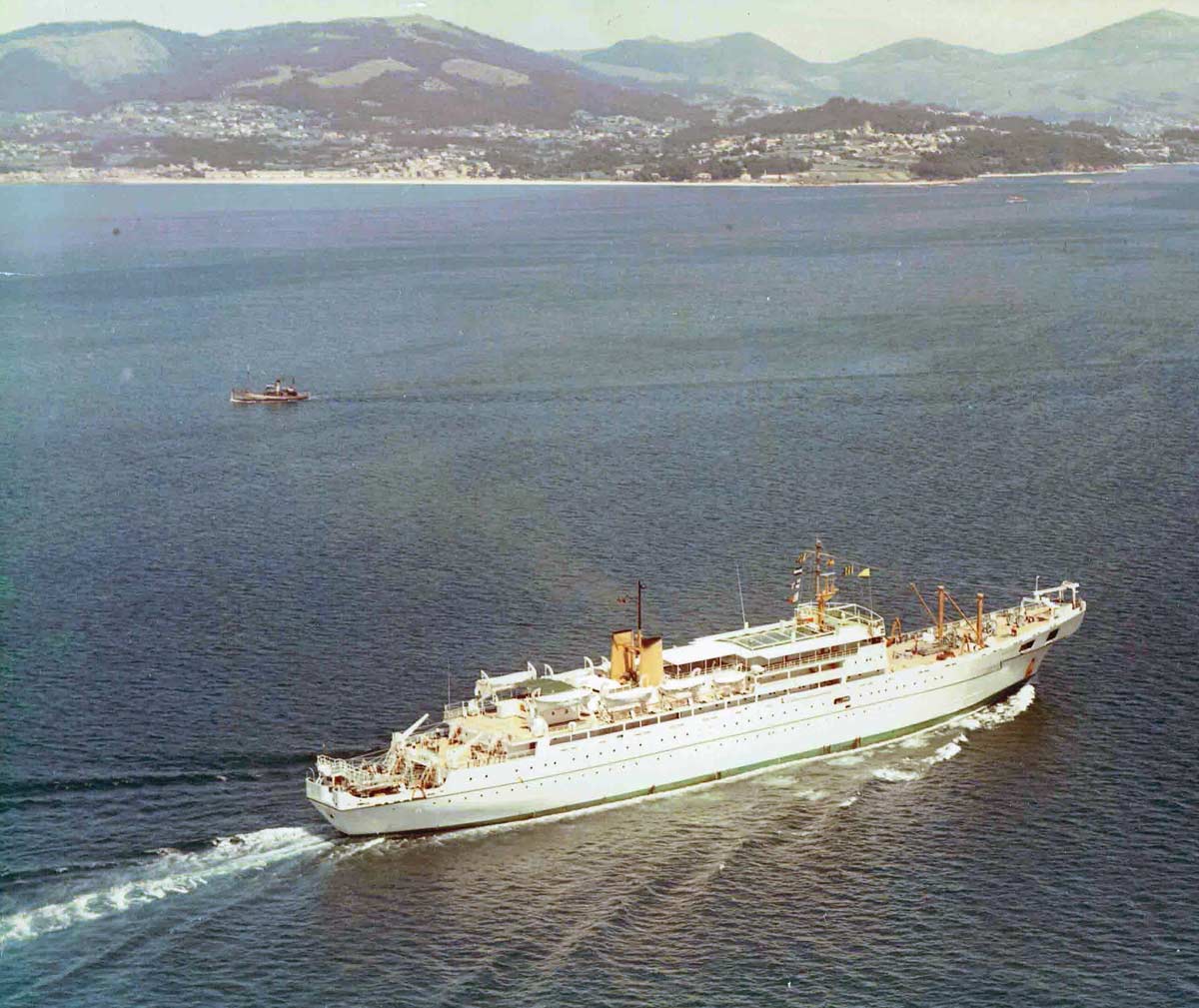
These final photographs show Mercury at Cape Town, and at Vigo, Spain, both probably taken in 1964.
The Atlantic Cable website is non-commercial,
and its mission is to make available on line
as much information as possible.
You can help - if you have cable material,
old or new, please contact me. Cable samples, instruments, documents,
brochures, souvenir books, photographs,
family stories, all are valuable to
researchers and historians.
If you have any cable-related items
that you could photograph, copy,
scan, loan,
or sell, please email me: [email protected]
—Bill Burns, publisher and webmaster: Atlantic-Cable.com